School and university greenhouse for hands-on plant science education

Schools & Universities

A school greenhouse is part of the curriculum, the campus, and often a funding application — it needs to be safe for students, durable under daily use, and priced clearly enough for a grant or board vote. Configure a teaching greenhouse and see real materials pricing now, without waiting weeks for a quote.

Find your starting point

Greenhouse needs change with the level of program. Here's where each typically starts—by size, budget, and focus.

These ranges are general planning figures for the overall program and can include costs beyond the greenhouse structure and equipment. Conley's provides a project-specific estimate based on the selected greenhouse and scope.

Elementary & Middle School

Typical size
200-800 sq ft
Typical program budget
$15,000-$40,000

Introduction to plant science and basic STEM integration. Simple operation, safety, and low maintenance are the priorities.

High School

Typical size
1,200-2,880 sq ft
Typical program budget
$60,000-$200,000

FFA programs, horticulture curriculum, and real plant production. Code compliance, durability, and curriculum flexibility matter most.

College / Community College

Typical size
2,000-5,000 sq ft
Typical program budget
$150,000-$400,000

Advanced horticulture programs, plant science degrees, and vocational training. Customization for curriculum and multiple growing zones become important.

University Research

Typical size
2,000-10,000+ sq ft
Typical program budget
$200,000-$1,000,000+

Plant science research and controlled environment agriculture. Precise environmental control, isolation/containment, and integration with monitoring systems are essential.

Class-only or production-focused?

This is the key question that determines how much space you actually need. Identify which mode fits your program before sizing anything.

Class-Only

The greenhouse is used primarily for instruction. Students rotate through during class periods. Plants grown support the curriculum but are not produced at commercial scale.

Sizing implication

The 60 sq ft per student standard applies cleanly. A typical class of 20-30 students needs 1,200-1,800 sq ft.

Production-Focused

The greenhouse supports instruction AND produces plants at meaningful volume — for fundraisers, FFA plant sales, community-supported agriculture, restaurant partnerships, or the school cafeteria.

Sizing implication

Needs substantially more space than the per-student standard suggests, to accommodate dedicated production zones alongside teaching zones. Often 30x96 or larger.

How big should your greenhouse be?

Greenhouse area
60 sq ft of greenhouse area per student
Bench space
30 sq ft of bench space per student
Typical class size: 20-30 students
Typical range: 1,200-2,880 sq ft for most high school programs
Example20 students × 60 sq ft = 1,200 sq ft

Production-focused programs need more space than these standards suggest. Ask whether the school is class-only or also producing plants for sale or community programs.

Example configurations

Real configurations with live materials pricing — starting points for grant applications and board presentations, not fixed menus. Open one in the configurator to adjust size, equipment, and climate for your project.

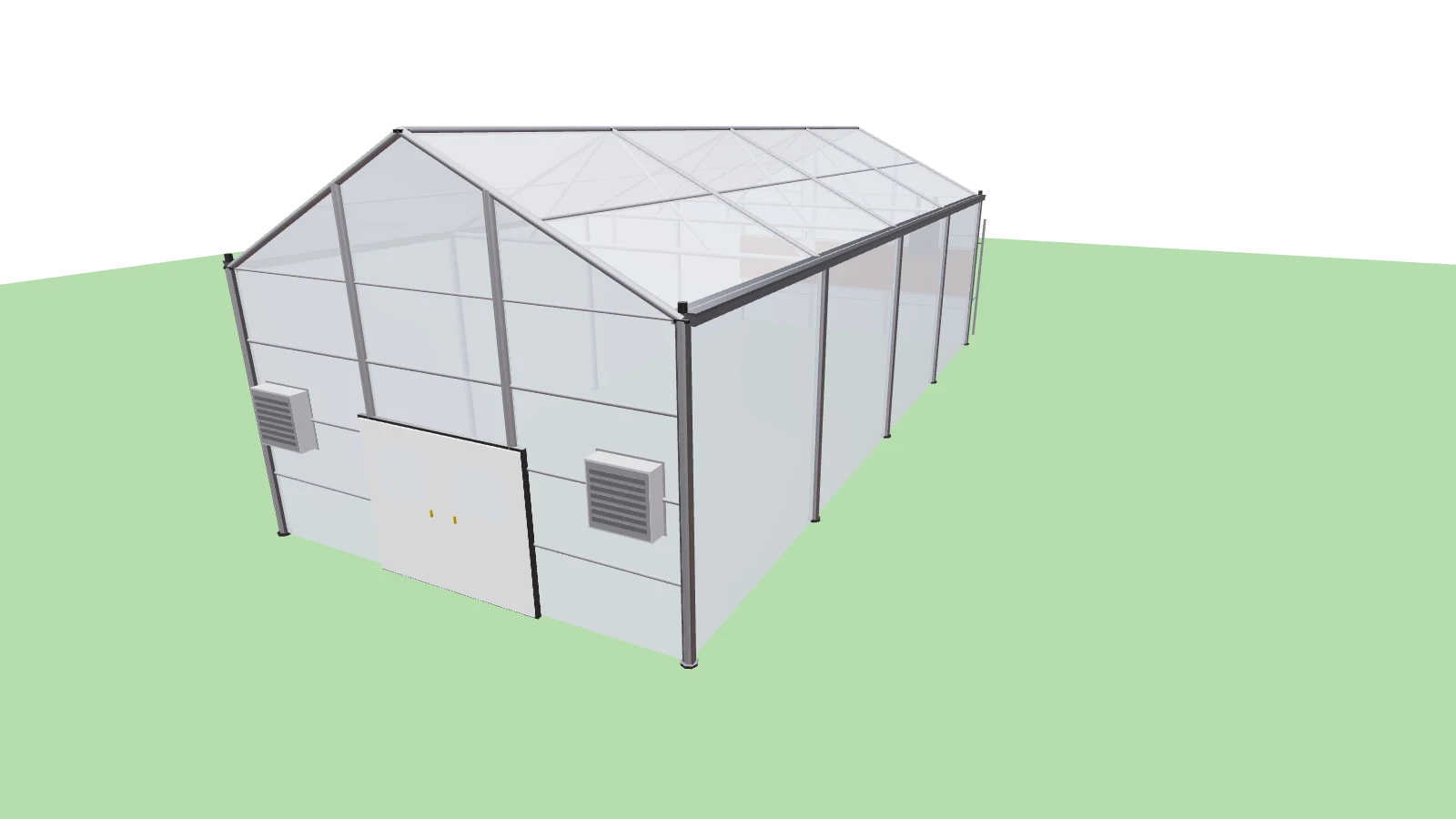
3D visualization — Compact teaching greenhouse

Elementary, middle school & small programs

Compact teaching greenhouse

21' × 48' · 1,008 sq ft · 7500 Series

Calculating…

Materials estimate loading…

A fully equipped teaching greenhouse at 1,008 sq ft — fan-and-pad cooling, heating sized for a cold-climate school, and insulated doors. Schools often arrive more fully equipped than size alone would suggest, because grants and capital budgets can cover climate control that commercial growers have to justify against margin.

What's included

  • Frame (12' OC – 8' OC truss spacing)
  • Covering (8mm twin wall, clear – SolarSoft)
  • Doors (1 double-swing insulated steel)
  • Fan & pad cooling (2 exhaust, 2 HAF, evap pad, end-wall vent)
  • Forced-air heater (1 × 123,000 BTU)
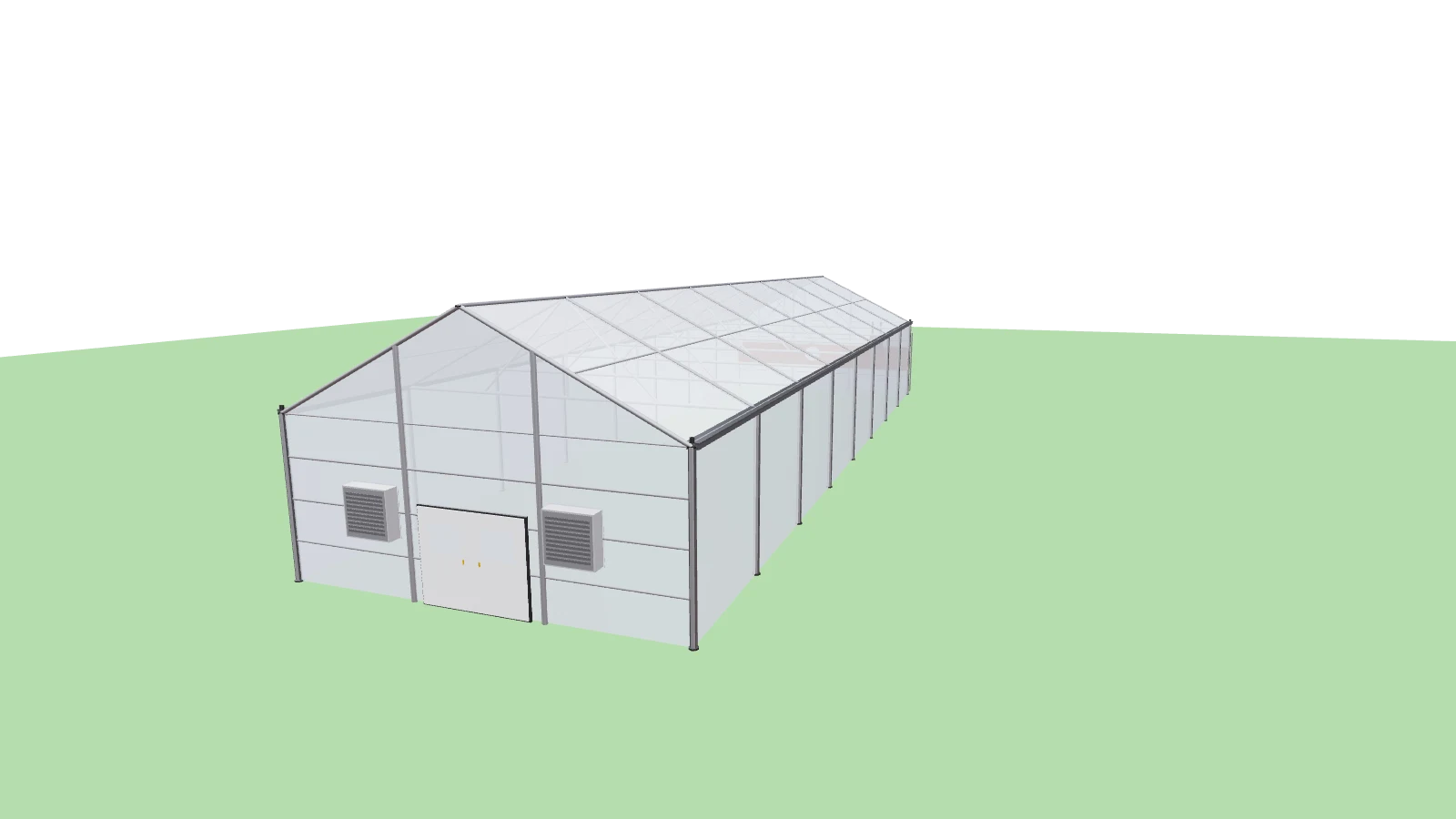
3D visualization — Mid-size teaching greenhouse

High school class programs & FFA

Mid-size teaching greenhouse

30' × 96' · 2,880 sq ft · 7500 Series · 12' UGH

Calculating…

Materials estimate loading…

The same fully equipped climate package as the compact school example — fan-and-pad cooling, evaporative cooling, end-wall vent, and forced-air heat — in a 30' × 96' single-bay 7500. At 2,880 sq ft this fits the upper end of typical high school class sizing and gives room for dedicated teaching and production zones.

What's included

  • Frame (12' OC – 8' OC truss spacing, 12' UGH)
  • Covering (8mm twin wall, clear – SolarSoft)
  • Doors (1 double-swing insulated steel)
  • Fan & pad cooling (exhaust, HAF, evaporative pad, end-wall vent)
  • Forced-air heater(s) sized for your climate

Built for school code requirements

Schools face stricter code treatment than agricultural greenhouses. Here's how we handle the most common requirements.

Stamped engineered drawings
80 years of experience providing stamped, engineered drawing packages for institutional projects.
Additional jurisdictional review for school buildings
Some jurisdictions—including California K-12—require additional review processes for buildings where students will be present. Ask your local building authority what applies to your project, then work with your sales rep to choose a structure series that can meet those requirements.
Project-specific snow and wind load engineering
Every structure engineered to local snow and wind load requirements.
ADA accessibility
Designs accommodate accessible entry and circulation for student access.
Fire code compliance for coverings
Covering options that meet institutional fire code requirements.
IBC institutional occupancy
Familiar with the stricter code treatment schools receive vs. agricultural greenhouses.

How schools use their greenhouse

Curriculum Integration

  • STEM/STEAM education
  • FFA programs
  • Horticulture and floriculture coursework
  • Farm-to-table programs
  • Vocational/CTE training
  • Special education and therapy programs
  • University plant science research

Community Engagement

  • Open houses for parents and donors
  • School-hosted plant sales
  • Community education workshops
  • Partnerships with senior centers and libraries
  • Field trips for feeder schools

Revenue & Partnerships

  • Renting bench space to local growers during off-curriculum periods
  • Restaurant partnerships for specialty produce
  • Community-supported agriculture programs
  • University feeder program partnerships
  • Corporate sponsorships and naming opportunities

Funding programs to know

Schools have more funding available for greenhouse projects than most realize, and the funding environment right now is unusually strong. The programs below are real and current, but eligibility, amounts, and application windows change each cycle — treat this as a starting map and confirm current details with each program. Many school projects combine more than one source: a grant covers the structure, a CTE budget covers equipment, a smaller grant covers the garden.

Grants that fund school greenhouses

USDA Patrick Leahy Farm to School Grant

The strongest single funding source for school greenhouse projects. These competitive federal grants fund farm-to-school programs, and the program explicitly supports purchasing greenhouses and associated educational materials. Recent cycles have awarded grants ranging from roughly $100,000 to $500,000. Schools operating the National School Lunch or Breakfast Program are eligible. Applications open once per fiscal year.

American Honda Foundation

A strong fit for school greenhouses with a STEM or environmental education focus. The foundation funds youth and scientific education, and public and private K-12 schools are explicitly eligible. Recent cycles have awarded grants in the range of roughly $20,000 to $75,000. The funding window typically opens in fall with decisions the following spring.

CHS Foundation Ag Teacher Grants

Real greenhouse funding for agricultural education programs — a Minnesota school received $20,000 specifically for a greenhouse in a recent cycle. Important limit: these grants are restricted to schools in CHS trade territory (Idaho, Illinois, Indiana, Iowa, Kansas, Minnesota, Missouri, Montana, Nebraska, North Dakota, Ohio, Oklahoma, Oregon, South Dakota, Texas, Washington, Wisconsin, and Wyoming). Schools outside that region aren't eligible. For schools inside it, recent ag-teacher grants have run in the $10,000 to $20,000 range for projects with a strong agricultural tie.

Other funding pathways worth knowing

Perkins V (CTE funding)

Perkins V is the primary federal investment in career and technical education, and it funds CTE programs including agricultural education. It isn't a grant a school applies for directly — the money flows to your state and your district allocates it. If your greenhouse supports a CTE or agricultural pathway, ask your district's CTE coordinator or state CTE office about using Perkins funds. Your district likely already receives them.

USDA NRCS EQIP

EQIP provides financial assistance to agricultural producers for conservation practices. It can apply to school greenhouses, but only when the greenhouse is part of a genuine agricultural production operation — a working school farm, not a classroom-only teaching greenhouse. If your program produces at meaningful scale, talk to your local NRCS office.

Whole Kids / WFM Foundation Garden Grant

A smaller grant (recent cycles around $3,500) for edible educational gardens at K-12 schools. It funds garden components — beds, irrigation, learning materials — rather than greenhouse structures. If your project includes a garden alongside the greenhouse, it can help with that piece, but won't fund the structure itself.

State Farm to School and school garden programs

Many states run their own Farm to School or school garden funding programs alongside the federal ones. These vary widely by state in amount, eligibility, and timing. Your state department of agriculture or education is the place to check what your state offers.

Common questions from school buyers

What features make a greenhouse safe for students?

A few things matter most for student safety. Polycarbonate covering rather than glass is the standard recommendation for schools — it's impact-resistant and doesn't shatter, which removes the biggest hazard glass would introduce. Wide doorways and clear circulation paths keep the space navigable for groups of students moving through at once. Sturdy benching at appropriate working heights keeps students working safely and comfortably. And the structure itself is engineered to local snow and wind loads, so it holds up to whatever your climate brings. When you configure a school greenhouse with us, these aren't upgrades you have to know to ask for — they're the defaults for institutional projects.

Will this meet our building department's requirements? Do you provide stamped drawings?

Most school greenhouses require stamped engineering drawings — drawings reviewed and stamped by an engineer licensed in your state — and some jurisdictions have additional review processes for buildings where students will be present. Some of our structure series can be engineered to meet these requirements; others can't, which is why knowing your requirements early helps you choose the right structure from the start. The most useful first step is asking your local building authority what they require for your specific project. Once you know, your sales rep can guide you toward the series that fits. We've spent 80 years navigating institutional code requirements, so this is familiar territory.

What grants and funding are available for school greenhouses?

More than most schools realize, and the funding environment for school greenhouse projects is unusually strong right now. Federal programs include USDA Farm to School grants, Perkins V career and technical education funding, and NRCS EQIP for high tunnels. Many states run their own Farm to School and school garden programs. Private foundations fund these projects too — the American Honda Foundation, CHS Classroom Grants, and Whole Kids Foundation among them. Many school projects combine more than one source: a grant covers the structure, a CTE budget covers equipment, a foundation grant covers the rest. The funding programs section on this page lists specifics with links.

How big should our greenhouse be for our program?

The widely used standard is about 60 square feet of greenhouse area per student, with roughly 30 square feet of bench space per student. For a typical class of 20 to 30 students, that points to somewhere in the range of 1,200 to 1,800 square feet for most high school programs. But there's an important distinction worth thinking through first: are you building a class-only greenhouse focused on instruction, or a production-focused greenhouse where students also grow at meaningful scale for sales, a CSA, or community programs? Production-focused programs need more space than the per-student standard suggests. The educational level guide on this page breaks down typical sizes and budgets by program type, and your rep can help you size for your specific situation.

What can we teach with a greenhouse? How do other schools use theirs?

Schools use their greenhouses across three levels. The first is curriculum — plant science, STEM, FFA and horticulture programs, farm-to-table education, career and technical education, and special education programs all run through the greenhouse. The second is community — open houses, plant sales, partnerships with senior centers and libraries, field trips, and public events that turn the greenhouse into a visible school asset. The third is revenue and partnerships — some programs rent bench space to local growers, supply restaurants, run CSA programs, or attract sponsorships that help sustain the program financially. The greenhouse is rarely just a classroom; the strongest programs use it across all three.

Can students use the greenhouse year-round? In winter and summer?

Year-round use comes down to equipment, and what your climate requires. For cold-season use, unit heaters keep the greenhouse in its growing range through winter. For hot weather, ventilation and evaporative cooling manage summer heat. The equipment you select determines how far into each season your program can operate. If year-round programming matters to your curriculum, that's worth designing for from the start rather than adding later. Summer use is also where the community and production side of many programs lives, since students are out but the growing continues.

How much maintenance does a school greenhouse require? What happens if our teacher changes?

Greenhouse equipment needs routine upkeep to perform reliably — keeping evaporative cooling pads clean, checking fan motors, replacing covering as it ages over time, and checking structural connections. None of it is complex, but it does need to happen consistently. The teacher-turnover question is a real one for schools, and the practical answer is documentation: keeping basic operating and maintenance notes with the greenhouse rather than only in one teacher's head means a program survives a staffing change. The structures themselves are built to last decades — Conley's greenhouses from the 1960s through 1980s are still operating at schools and institutions — so the structure long outlives any single teacher.

Can we install during summer break?

Summer installation is a common goal for schools, since it avoids disrupting the school year and gives a new program time to get established before students return. Whether it's achievable for your project depends on your timeline — funding approval, procurement, engineering review, and manufacturing all happen before installation, and institutional procurement in particular can take longer than schools expect. The practical move is to work backward from your target summer and start early. If a summer install matters to you, tell your rep up front and they'll be honest about what's realistic given where you are in the process.

Is the greenhouse ADA accessible? What are the requirements?

Schools are public facilities, so accessibility matters. Greenhouses can be configured with accessible entry and circulation — appropriate door widths, navigable aisle spacing, and bench heights that work for students using wheelchairs. Specific requirements vary by jurisdiction and by whether the greenhouse has general public access, so your local building authority is the authority on what your project needs. When you know your requirements, we can configure the structure to meet them.

Will a greenhouse work in our climate?

Yes — greenhouses operate in every climate in North America, from Minnesota winters to Arizona summers. What changes by climate is the equipment, not whether it works. Cold climates need heating sized for the coldest expected day and structures engineered for snow load. Hot climates need significant ventilation and evaporative cooling. Your location drives those decisions, which is why one of the first things your rep will ask about is where the greenhouse will be built. The configurator and your rep size the equipment to your climate.

What's the total project cost, including site prep and installation?

The greenhouse structure is one part of a complete project, and it's the part the configurator prices for you directly and immediately. Beyond the structure, a complete school project typically includes site preparation (grading, drainage, foundation work), utility connections (water, electrical, gas if you're heating), installation labor, permitting and engineering fees, and your first-year operating budget. The total project cost is meaningfully higher than the structure alone, and the additional costs depend heavily on your specific site and local conditions. When you build funding requests and board presentations, plan around total project cost, not just the structure. Your rep can help you think through what your specific situation is likely to involve beyond the structure.

What does it cost to operate a school greenhouse annually?

Operating costs are mostly energy (heating and cooling), water, and growing supplies, and they vary widely by climate, by how much of the year you run the greenhouse, and by what you grow. A program running year-round in a cold climate has higher energy costs than a spring-and-fall program in a mild one. The equipment choices you make up front — particularly heating and cooling — are the biggest driver of ongoing operating cost, which is one reason it's worth thinking about operating budget during the design phase rather than after. Your rep can help you understand the operating implications of different equipment choices.

Why schools choose Conley's

Transparent online pricing

See real pricing for your configuration instantly — essential for grant applications and school board presentations that require specific budget numbers. No waiting weeks for a quote.

80 years of durability

Conley's greenhouses have served schools and institutions since the 1960s. Your greenhouse will outlast multiple generations of students.

Engineering credibility

Rolled-form galvanized steel, condensate management, stamped drawings, and code compliance experience that institutional buyers can rely on.

California-based manufacturer

Designed and manufactured in California, with familiarity navigating California-specific requirements.

Multi-vendor orchestration

We coordinate the equipment, climate control, and systems so schools work with one accountable partner instead of juggling multiple contracts.

Dedicated School Projects Specialist

Ryan Moore works directly with educational buyers and understands how schools buy.

Price a school greenhouse

Configure dimensions, covering, and equipment for a teaching greenhouse — live materials pricing you can take to a grant application or school board presentation.