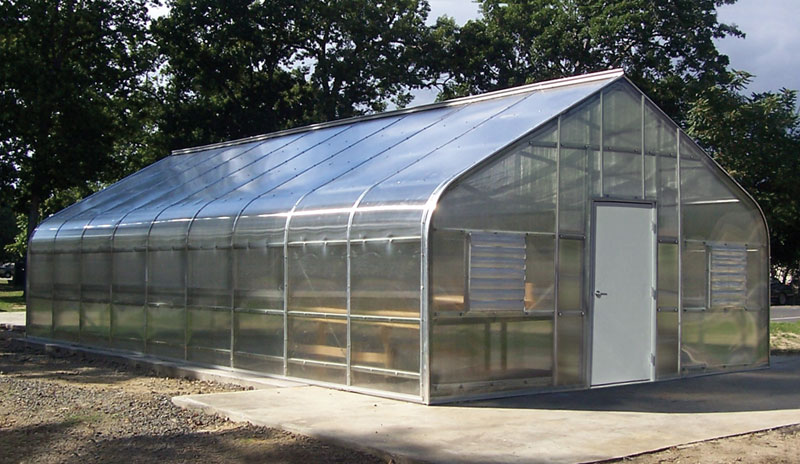
Community & Small-Scale
A real, durable, properly engineered greenhouse isn't only for large operations — community gardens, nonprofits, schools, and small or first-time growers build with us too. You can see what a structure actually costs right now, without a sales call.
Finding the right structure when you're starting out
High tunnel, hoop house, and greenhouse all describe a walk-in arched or gabled structure — the terms overlap. Some people reserve "greenhouse" for heated structures and "high tunnel" for unheated; it is not a universal rule. Locate yourself by what you need to grow, not by budget anxiety.
High tunnel / hoop house
Simple structure over bare ground or raised beds — passive solar heat and passive ventilation through roll-up sides. Lowest cost path for season extension; crops often grow in the ground.
Cold frame / basic structure
Functional protected growing with sidewalls and durable framing — the starter tier many small farms and community projects begin with. Simple, engineered, gets the job done.
Equipped greenhouse
Active climate control — heat, mechanical ventilation, and cooling as needed — for year-round growing or more demanding crops. More capability when passive season extension is not enough.
Where Conley's fits
This is the segment transparent pricing and the configurator serve best. Self-price a structure, get a real number for a grant application, committee vote, or NRCS paperwork, and skip the sales-call friction. Small scale is not lesser — the structure should still be real, durable, and engineered.
Schools & universities
Small school and education gardens with institutional requirements.
Commercial production
When you outgrow a starter structure and need production-scale layout.
NRCS High Tunnel Initiative
Official program page — eligibility, application steps, and local office lookup.
Commercial greenhouse planning guide
Site, permits, and phased planning when your project grows beyond a starter footprint.
Ground-to-ground arch cold frame — cost-effective season extension and high-tunnel-style growing.
Arch with sidewalls — roll-up sides, ventilation, and optional heat for the most common starter path.
Wide gothic cold frame — extra clearance for taller crops and tougher weather.
Compact gothic arch for home and small educational gardens — contact us for sizing and availability.
Small working farms and first-time growers often decide quickly when friction is low — that is what self-serve pricing is for. Price 1000, 1100, and 1200 series in the cold-frame configurator now; your rep can help if you need something outside those lines.
Funding a small or community project
Small and community projects often combine donations, grants, and cost-share programs. Eligibility, rates, and application windows change each cycle — confirm current details before you plan around any program.
High-fit program for community and small-scale growers
USDA NRCS High Tunnel System Initiative (EQIP)
Financial assistance for high tunnels as a conservation practice — extending the growing season and protecting crops. Available to urban and rural producers, local farmers, businesses, and farming groups, not only large rural farms. Recent federal cycles have used per-square-foot reimbursement rates roughly in the $5.90–$12.21 range, up to a size cap based on about 2,160 sq ft — rates and caps vary by state and year. The application process includes registering with the Farm Service Agency, obtaining a farm tract number, and working with a local NRCS representative. An approved manufacturer quote is required — which is exactly what transparent online pricing produces without waiting on a sales call. NRCS is cost-share reimbursement, not a guaranteed free greenhouse; some projects are fully funded, others are not. Confirm current rates and eligibility with your local NRCS office.
Common questions from community and small-scale growers
What's the difference between a high tunnel, hoop house, and greenhouse?
They overlap. All describe a walk-in structure for protected growing. Many growers use high tunnel or hoop house for passive, unheated season extension, and greenhouse when they mean active heating and year-round control — but the terms are not used consistently everywhere. Focus on whether you need passive season extension or equipped climate control; the structure tier follows from that.
Can a small community garden really buy from a commercial manufacturer?
Yes. Community gardens, nonprofits, and first-time growers are a real part of what we build. You do not need a large operation to get a properly engineered structure — and you can see materials pricing for starter series in the configurator without a sales call.
Is there funding for a community or small-scale greenhouse?
Often yes, through a mix of sources. The USDA NRCS High Tunnel System Initiative is a strong fit for many community and small-scale growers — cost-share reimbursement for high tunnels as a conservation practice, with an application process through your local NRCS office. Rates and eligibility vary by state and year; it is not a guaranteed free greenhouse. Donations, local grants, and foundation funding are common for nonprofit community projects too.
Do I need heating, or is a passive structure enough?
If your goal is extending the season — starting earlier in spring and finishing later in fall — a passive high tunnel or cold frame with roll-up sides is often enough. If you need year-round production or tight temperature control through winter, you need an equipped greenhouse with active heat and ventilation. Match the structure to the growing schedule you are planning, not the most capable option on the list.
Can I get a quote for my NRCS application?
Yes. NRCS applications require an approved manufacturer quote. Configure a 1000, 1100, or 1200 series structure in the cold-frame configurator and generate live materials pricing — the number you need for paperwork, without waiting on a sales call. Confirm with your local NRCS office that your configuration meets current program requirements.
See what a structure costs
Configure dimensions and equipment for a cold-frame or starter greenhouse — live materials pricing you can use for a grant, board vote, or NRCS application.