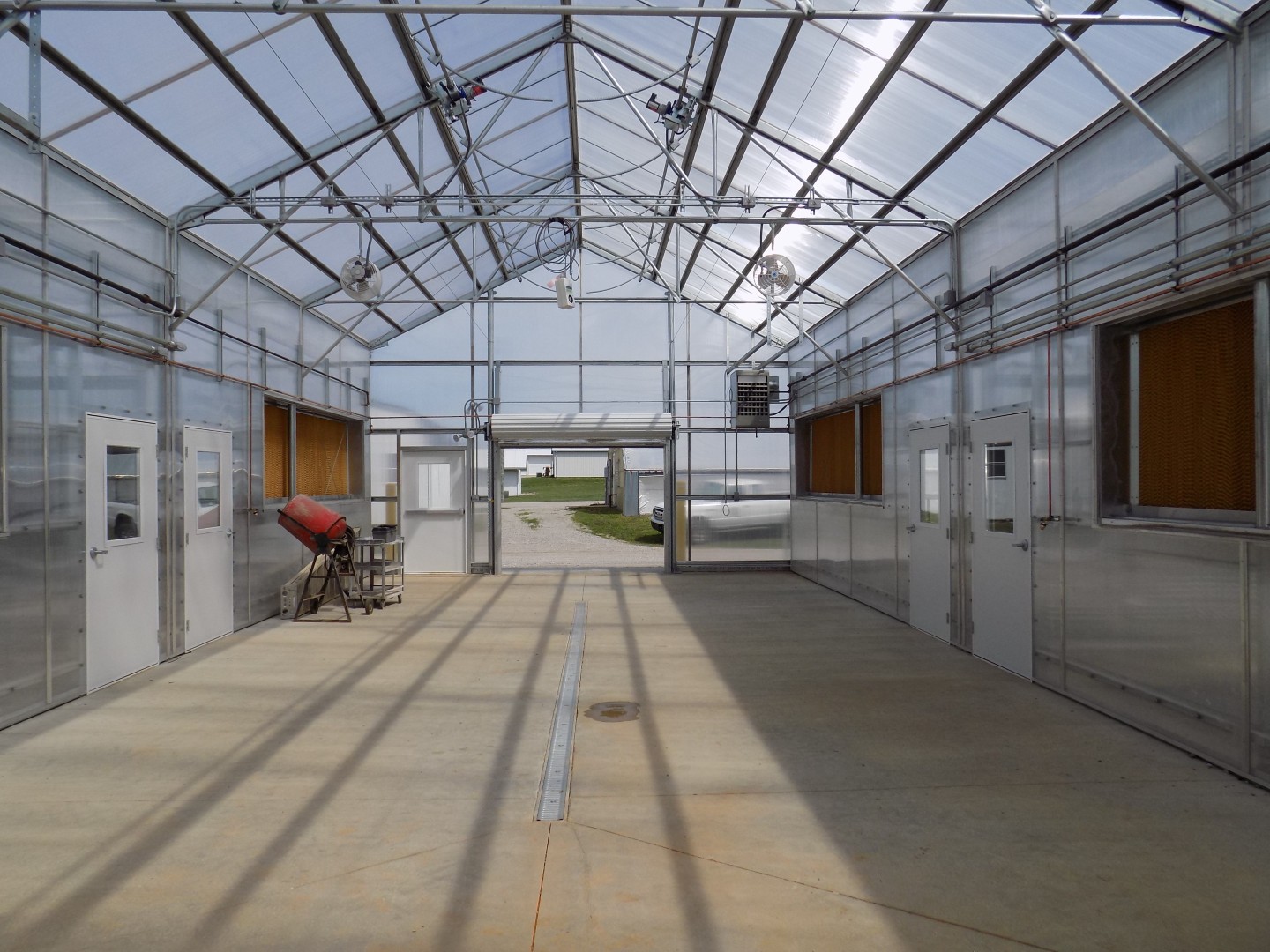
Research & Development
A research greenhouse isn't built to grow the most — it's built to control variables so results are valid. Uncontrolled environmental variation isn't just inefficiency; it's experimental error. That reframes the structure from growing space to controlled experimental environment — and it's why research facilities are built unlike any other greenhouse.
Why research demands experimental control
Research buyers evaluate structure through experimental validity — general research fundamentals, not Conley's performance claims.
Variation is the enemy
Within-greenhouse variation, greenhouse-to-greenhouse variation, and period-to-period variation are known sources of error in greenhouse experiments. Controlling them is the whole point of a research facility.
Replication drives the structure
When environmental settings define a treatment, the compartment is the experimental unit — you need multiple independently controlled compartments at the same setting to estimate experimental error. Plants in a single compartment are subsamples, not replicates.
Control must be documented
Research-grade environments require measuring and logging actual conditions — light, temperature, humidity — throughout an experiment. The environmental data is part of the science, not just a comfort setting.
How many compartments, and at what level of control?
Research often needs many small, independently controlled compartments running different treatments at once — each a valid experimental unit. The central structural question is how many compartments you need, how independently they are controlled, and how they are served.
Many small compartments
Multiple independent chambers under one roof — each runs its own treatment with fine-grained control. The standard layout when you need concurrent experiments and true replication.
Fewer larger zones
Larger treatment blocks with replication across fewer, bigger compartments. Suits programs running fewer concurrent treatments or breeding work that needs more plants per unit.
What that layout implies
Many small compartments
Each compartment is an experimental unit — independent setpoints, shared service corridors.
Independent environmental control
Temperature, humidity, light intensity, and CO₂ controlled per compartment — not averaged across the house.
Partition and service layout
Internal walls, doors, and utility routing so compartments are serviced and controlled separately without cross-contamination of treatments.
Concurrent treatments
Run multiple experiments at once — the layout research literature assumes when replication and blocking matter.
Where Conley's fits
Research facilities are design partnerships, not configurator checkouts. Compartment count, partition design, and control integration are worked out with your team — alongside your institution's procurement process and your controls, irrigation, and energy specialists. Conley's is the structure-and-controlled-environment partner in that mix. Research may also require containment for transgenic work, pathogen studies, or quarantine — a regulated design conversation with your institution, not a standard catalog option. Containment can involve screening on openings, double-door entries, tailored ventilation, and closed compartments where required; specific levels are engineered to your protocol and regulatory context.
Schools & universities
University research facilities share institutional code requirements — stamped drawings, accessibility, and public-building considerations.
Propagation & young plants
Research propagation and breeding programs with young-plant precision demands.
Commercial greenhouse planning guide
Site, permits, utilities, and phased planning for institutional facilities.
Request a quote
Design conversation for compartmentalized, custom research facilities.
7500 Series cost guide
Live-priced 7500 builds — useful ballpark numbers for grant and capital requests.
Gable series for compartmentalized research — internal partitions, engineered loads, and integration with research-grade control systems.
Stamped-engineering gothic line when institutional permits and code documentation are part of the project.
Transparent online pricing is genuinely useful for early institutional budgeting — a researcher writing a grant or capital request needs a real number. For a custom, compartmentalized facility, the configurator is a starting budget; the design conversation is how these projects close.
Common questions from research buyers
Why do research greenhouses need multiple compartments?
When an environmental setting defines a treatment, the compartment is the experimental unit — not individual plants. You need multiple independently controlled compartments at the same setting to estimate experimental error. That is why research facilities have many small controlled chambers: it is experimental-design necessity, not convenience.
Can you build to containment requirements?
Research often requires containment for transgenic work, pathogen research, or quarantine — and it is regulated. Containment is a design conversation we work through with you and your institution, involving screening, airlocks, ventilation strategy, and closed compartments where needed. Specific containment levels are engineered to your protocol and regulatory context — not selected from a catalog line item.
How does the buying process work for a research facility?
These are custom design partnerships on institutional timelines — compartment layout, partition design, and control integration are developed collaboratively. Multiple stakeholders and vendors are normal: Conley's supplies structure and controlled environment; research-grade controls, irrigation, and specialized systems typically come from other specialists we coordinate with.
Can I get a budget number for a grant proposal?
Yes — the configurator gives live ballpark structure pricing without a sales call, which is useful when a grant or capital request needs a real number early. For compartmentalized research facilities, treat that as a starting budget; final scope is worked out in a design conversation.
Start a research facility conversation
Compartment count, partition design, and control integration are worked out collaboratively — request a quote for a design conversation, or use the configurator for early grant and capital-request ballpark numbers.